Ready to Plan
Your Safari?
Our Tanzania safari and adventure experts craft personalised, tailor-made itineraries — just for you.
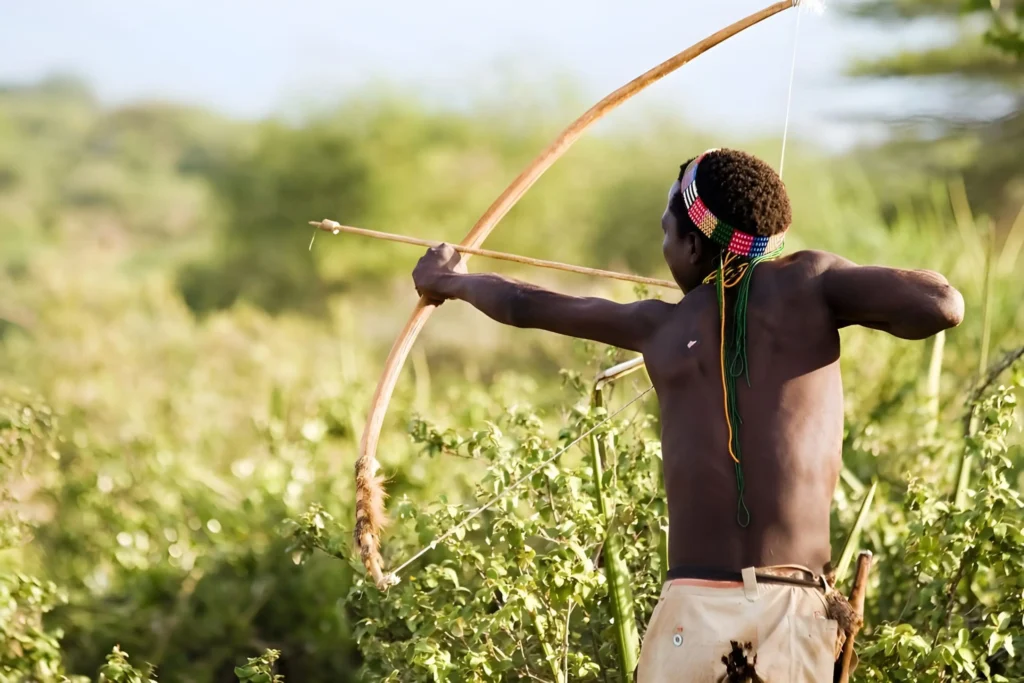
When you step into the golden grasslands of Lake Eyasi at dawn, the air isn’t just cold; it’s electric with the anticipation of a lifestyle that has remained unchanged for over 50,000 years. At Tanzania Safari Experience, we don’t just take you to see the Hadzabe; we walk beside you as you witness the final chapter of human history’s original story.
The Hadzabe hunting experience is an immersive, high-energy journey where visitors join Tanzania’s last true hunter-gatherers on a morning forage, witnessing ancient survival skills, traditional archery, and profound communal harmony.
I remember the first time our team sat by a Hadzabe fire. There was no “hello” in the way we know it—only a rhythmic clicking of their unique language and a shared pipe of tobacco. The Hadzabe are not performers; they are a resilient community of roughly 1,200 people living around the Eyasi basin. They don’t grow crops, they don’t keep livestock, and they don’t answer to the ticking of a clock.
Pro-Tip: Most tourists arrive at 8:00 AM. By then, the hunt is over. If you want the real experience, you must be at their camp by 5:30 AM. The “Golden Hour” here isn’t for photos; it’s for survival.

Unlike the lush plains of the Serengeti, Lake Eyasi is rugged, dusty, and filled with acacia thorns. This harshness is exactly why the Hadzabe culture has survived. The land is difficult to farm, which kept modern civilization at arm’s length for centuries.
When the men decide it’s time to hunt, there is no formal meeting. They simply grab their bows and move.
What to expect during the hunt:
The Hadzabe hunt is fast. You won’t be strolling down a path. You will be jogging through thickets, ducking under “Wait-a-Bit” thorns, and jumping over rocks. They hunt birds, dik-dik, and occasionally larger kudu.
| Feature | Hadzabe Traditional Gear | Modern Hunting Gear |
| Weapon | Hand-carved bows from Msuaki wood | Compound bows or rifles |
| Strings | Giraffe or Impala sinew | Synthetic fibers |
| Arrows | Wood with bee-propolis and bird feathers | Carbon fiber |
| Tracking | Animal sounds and wind direction | GPS and binoculars |
The Secret of the Arrows:
Look closely at their quivers. You’ll see different arrows. The ones with the blunt wooden heads? Those are for small birds to keep the meat intact. The ones smeared with a dark, sticky paste? That’s poison made from the Adenium coetaneum (Desert Rose). It’s powerful enough to bring down a zebra, yet the meat remains safe for us to eat.
While the men are away, we often stay back with the women and children. This is where the true “Information Gain” happens. While hunting gets the glory, it’s the foraging that keeps the tribe fed daily.
What is Hadzabe foraging?
Hadzabe women are experts in botanical science, gathering tubers, berries, and baobab fruit using sharpened digging sticks to provide the majority of the tribe’s daily caloric intake throughout the year.
In 2026, the Baobab remains their supermarket. They use the fiber for rope, the fruit for a Vitamin C-rich powder, and the hollow trunks for shelter during the rains. We’ll show you how they mix the white baobab powder with water to make a tart, energizing drink that tastes like a citrus smoothie.

There are no matches here. I’ve tried to mimic their technique many times, and usually, I just end up with sore palms. They use two sticks: a hard “male” stick and a soft “female” stick. By spinning the hard stick into a notch in the soft one, they create a spark in under 30 seconds.
Expert Insight: They use the dung of a dik-dik or zebra as the “tinder” because it catches the spark instantly. It’s a smell you’ll never forget—earthy, smoky, and ancient.
We feel a heavy responsibility when bringing guests here. This isn’t a zoo. To ensure we are helping and not hurting, we follow strict guidelines:
No Handouts: We do not give candy or money directly to children. This creates a culture of begging. Instead, we support the community through established village fees that pay for medical care.
Ask Before You Snap: Always look for a nod of approval before taking a portrait.
The “Quiet Rule”: On the hunt, silence is life. If you talk, the prey runs, and the tribe goes hungry.
When is the best time to visit the Hadzabe?
The best time is the Dry Season (June to October) when animals congregate near water sources and the bush is less dense, making it easier to keep up with the hunters.
Long Trousers: The thorns in Eyasi are unforgiving.
Sturdy Trail Shoes: You will be running.
Neutral Colors: Avoid bright whites or yellows; they scare off the birds.
A Small Gift: If you want to bring something, high-quality arrowheads or honey are deeply appreciated by the elders.
| Experience | Luxury Lodge (Ziwani/Kisampa) | Mobile Bush Camp |
| Comfort | Hot showers, fine dining, soft beds. | Bucket showers, campfire food, thin mattress. |
| Location | 30-minute drive to the Hadzabe. | You wake up to the sound of their morning fire. |
| Vibe | Relaxed and pampered. | Raw, dusty, and deeply connected. |
Explore our [Tanzania Safari Itineraries] for more cultural immersion.
One of the most incredible things I’ve witnessed is the relationship between the Hadzabe and a small bird called the Greater Honeyguide. The hunter will whistle a specific tone, and the bird will actually lead him to a beehive. After the hunter smokes out the bees and takes the honey, he leaves the wax for the bird. It’s a rare example of inter-species cooperation that sounds like a fairy tale but happens every day in Eyasi.
Do the Hadzabe speak Swahili?
Most do not. They speak Hadzane, a language characterized by four distinct clicks. A few younger members know basic Swahili to trade for salt or kale.
Is the hunting experience “staged”?
Not with us. If the hunters come back empty-handed, they go hungry. You are witnessing their actual daily struggle for calories.
Is it safe for children?
Yes, for kids aged 10 and up who can handle a bit of hiking. It’s the best history lesson a child could ever have.
What do they eat besides meat?
Tubers (like wild potatoes), berries, and the “white gold” of the bush—wild honey.
How long does the visit last?
Usually 3 to 4 hours. By 10:00 AM, the heat becomes intense, and the tribe retreats to the shade to craft tools or rest.
Why Go?
The world is changing fast, and the Hadzabe are at a crossroads. Visiting them isn’t just about a “cool photo”; it’s about acknowledging a way of life that values community over consumption and nature over technology.
At Tanzania Safari Experience, we ensure your visit is handled with the utmost dignity. We don’t just drive you there; we bridge the gap between two worlds. If you want to feel truly small in the face of history, this is the journey for you.