

Ready to Plan
Your Safari?
Our Tanzania safari and adventure experts craft personalised, tailor-made itineraries — just for you.
These are sample itineraries. All our trips are tailor-made and fully customizable*. We’ll adjust every detail to suit your wishes, interests, and travel style. *Except for group trips
Per Person On Twin Sharing
Per Person On Twin Sharing
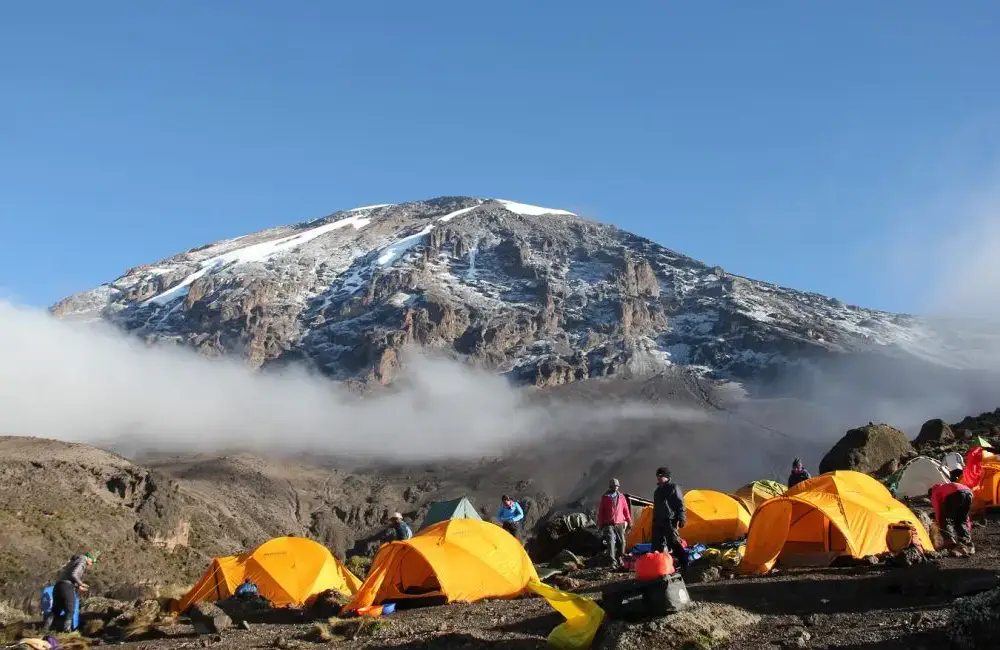
Standing at 5,895 meters above sea level, Mount Kilimanjaro is not just a mountain; it is a world of its own, shifting from humid rainforests to arctic deserts in a matter of days. When we lead our teams toward Uhuru Peak, we aren’t just looking at a summit; we are managing a complex equation of biology, meteorology, and grit.
At Tanzania Safari Experience, we’ve seen thousands of trekkers stand where the air is thin and the sun rises over the Mawenzi peaks. Through those years, we’ve learned that the “Roof of Africa” respects preparation over ego. In this guide, updated for 2026, I will break down the essential logistics of costs, safety, and route selection that will determine whether you reach the top or turn back early.
Kilimanjaro success rates average 65–70% across all climbers, but this figure jumps to over 95% on 8 or 9-day routes like the Northern Circuit, where acclimatization is naturally prioritized.
Success on this mountain is a math problem: Time = Oxygen. The greatest mistake I see climbers make is trying to “conquer” the mountain in five days. Your body cannot manufacture red blood cells fast enough to keep up with that kind of ascent.
| Route Duration | Average Success Rate | Risk of Altitude Sickness (AMS) |
| 5 Days | 27% | Extremely High |
| 6 Days | 44% | High |
| 7 Days | 64% | Moderate |
| 8 Days | 85% – 90% | Low |
| 9+ Days | 95%+ | Minimal |
Routes like Lemosho, Machame, Rongai, and the Northern Circuit have the highest summit success rates on Kilimanjaro with itineraries of 7 days or longer. We recommend choosing a 7–8 day climb as the optimal length to give your body enough time to acclimatize and to greatly reduce the risk of Acute Mountain Sickness (AMS).
The best time to stand on the “Roof of Africa” is during the two dry seasons: January to March and June to October. During these windows, the skies are generally clear, providing those iconic views of the glaciers and significantly better footing on the trails. We find that February and September are particularly special; the weather is incredibly stable, and your chances of a clear, dry summit push are at their highest.
While you can climb year-round, we usually suggest avoiding April and May. This is the peak of the “long rains,” where the rainforest at the base becomes a mudslide and the summit is often shrouded in heavy snow and thick mist. If you’re looking for the ultimate experience, try to time your trek with a full moon; the lunar light reflecting off the ice fields is so bright you can practically climb without a headlamp.
A high-quality Kilimanjaro climb in 2026 costs between $2,500 and $4,800, covering mandatory park fees ($800-$1,000), fair wages for a 12-person crew, and specialized safety equipment.
When you see a price under $2,000, ask yourself what is being cut. Usually, it is the two things you need most: nutritious food and ethical treatment of porters.
| Expense Category | Budget Operator | Mid-Range (Recommended) | Luxury |
| Price Point | $1,800 – $2,200 | $2,600 – $3,500 | $4,000+ |
| Crew Wages | Often below legal minimum | Fair/KPAP Compliant | Premium + High Bonuses |
| Safety Gear | Basic first aid only | Pulse oximeters + Oxygen | Portable Alt. Chambers |
| Meals | High carb/low protein | Fresh, varied nutrients | Three-course “Gourmet” |
| Toilet | Shared public long-drops | Private chemical toilets | Walk-in tent facilities |
Local Insight: The “Porter’s Economy” is the backbone of the mountain. We are proud members of the Kilimanjaro Porters Assistance Project (KPAP). Choosing an ethical operator ensures your crew is well-fed and properly clothed, which directly affects your safety—a happy, healthy guide is an alert guide.
Kilimanjaro safety relies on twice-daily health checks using pulse oximeters to monitor blood oxygen levels and heart rates, ensuring early detection of High Altitude Pulmonary Edema (HAPE).
We treat every climb like a medical expedition. On the mountain, our lead guides are certified Wilderness First Responders. We don’t just ask “how do you feel?” because, at 4,000 meters, everyone feels a little strange. We use data.
Oxygen Saturation Monitoring: We record your levels every morning and evening. If your oxygen drops below a certain threshold relative to the altitude, we increase your hydration and slow your pace.
The “Slow-Sip” Hydration Rule: You must drink 4 liters of water daily. We recommend adding electrolytes to your bladder—it’s not just about volume; it’s about retention.
Emergency Oxygen: We carry bottled oxygen on every trek. To be clear: oxygen is for descent and emergencies, not to help you “cheat” your way to the top. If you need oxygen to move upward, the mountain is telling you to go down.
Mount Kilimanjaro offers several routes to the summit, each with its own unique characteristics, challenges, and scenic beauty:
Booking your Kilimanjaro climb with us is simple — reserve your spot with just a 30% deposit. After that, you’ll receive access to your personal trip account, where you can easily fill in your medical information, allergies, food preferences, and gear details. Your consultant will stay in touch with you at every stage, ready to assist with any questions and help you prepare thoroughly for a safe and successful summit.
Kilimanjaro is a non-technical climb, meaning no ropes or climbing experience is required. However, it is physically demanding due to altitude. The biggest challenge is not fitness—it’s how well your body adapts to high elevation.
Success depends heavily on the route and number of days. Short routes (5–6 days) have lower success rates, while longer routes like Lemosho and Machame (7–8 days) significantly increase your chances, often above 85%.
No technical experience is needed. That said, good physical fitness and some hiking preparation will make your climb more comfortable and improve your chances of reaching the summit.
The best route depends on your goal.
As your safari experts at Tanzania Safari Experience, we usually recommend longer routes for better acclimatization and higher summit success.
We recommend at least 7 to 8 days for a safe and successful climb. Shorter itineraries increase the risk of altitude sickness and reduce summit success rates.
The best months are January to March and June to October, offering clearer skies and more stable weather. However, Kilimanjaro can be climbed year-round.
Prices typically range from $1,800 to $4,500+ per person, depending on route, duration, and level of service. This usually includes park fees, guides, porters, meals, and camping or hut accommodation.
Most packages include:
Flights, visas, tips, and personal gear are usually excluded.
Our tours are top-notch but give you great value. The price we tell you upfront covers most of the costs for one person, like flights and all transfers.
*For the most recent reviews/testimonials from our guests, please visit our TripAdvisor page and Trustpilot.
EXCELLENTVerified Safari May 2026 This company exceeded everything we’d hoped for. From the start, the tour operator had everything covered — a detailed itinerary laid out well in advance, quick responses to any questions, and a genuine attentiveness that made the whole thing feel effortless. The accommodation was seriously impressive. Not what I was expecting at all — comfortable, well-appointed, and luxurious. We also spent time right in the heart of the bush. A proper treat. The two people who really made this trip were our guide Mariki and photographer Agnes. Mariki’s knowledge of the bush and animal behaviour is something else — he always seemed to know exactly where to go, and his instincts paid off every single time. Agnes has a brilliant eye and captured shots we could never have got ourselves. As for the wildlife — we saw far more than we ever imagined we would. Elephants, lions, leopard, buffalo, giraffe, zebra, hippos — the lot. As a first safari, I couldn’t have asked for more. Would recommend without hesitation.Posted on TripadvisorVerified Great Experience with Tanzania Safari Experience We had an amazing safari with Tanzania Safari Experience, and honestly the whole trip was put together really well by Laurent and his team. From our first message to the last day, they were easy to reach, quick to reply, and clear about everything. The plan made sense, the timing was smooth, and we didn’t have to stress about anything. Uncle J was a big part of what made it special. He knows the parks incredibly well and seems to notice things before anyone else. He’d position the vehicle perfectly for photos and often got us to sightings before the crowds built up. We were lucky to see [your highlights: migration / lions / cheetahs / elephants / a crossing], and every drive felt exciting and different. The vehicle was comfortable and in good shape, and everything ran on schedule. If you’re looking for a well-organized safari with a great guide, I’d definitely recommend Tanzania Safari Experience.Posted on TripadvisorVerified An absolutely brilliant tour / travel company What can I say. How do you explain PERFECTION. I will try. From the outset of our trip Ramadhan and Laurent were excellent. We gave them our requirements and budget and they prepared a program that was outstanding. The whole safari went like clockwork. We were met and briefed by Ramadhan on our arrival and introduced to our driver and guide extraordinar Ngoi. We visited Tarangier, Serengeti, Ngorongoro and the Ngorongoro Crater and Zanzibar. Absolutely brilliant trip, we saw the most extraordinary game. All the accommodation arranged for us was magnificent, especially the tented camps, where we were visited by a lion and elephant, scary but exhilarating. So if you are looking for an unforgettable experience look no further than Laurent and Ramadhan from Tanzania Safari Experience. They truly put clients first and foremost and deliver on their promises. Cheers from a very satisfied Chris and Terri HarveyVerified by TrustindexTrustindex verified badge is the Universal Symbol of Trust. Only the greatest companies can get the verified badge who has a review score above 4.5, based on customer reviews over the past 12 months. Read more
Customer reviews will load after you allow external content.
Real insights from the ground—routes, costs, success tips, and what it actually takes to reach the summit of Mount Kilimanjaro.
Climbing the “Whiskey Route”: A Local’s Masterclass on the Machame Route If you want to feel the true heartbeat of Mount Kilimanjaro, …
Every time I stand at the Machame Gate, watching trekkers adjust their packs, I see the same look in their eyes—a mix …
Our Tanzania safari and adventure experts craft personalised, tailor-made itineraries — just for you.

Tanzania Safari Experience is a local Tour Operator specialist in Tanzania Safari, Kilimanjaro Trekking and Zanzibar Tours since 2013.
Travellers' Choice
★★★★★ Ranked on TripAdvisor
TALA Licensed Operator
Full Registered Company
OFFICE
Arusha, Tanzania — East Africa
PHONE & WHATSAPP
RESPONSE TIME
Within 24 hours, 7 days a week

We use essential cookies to keep the website working. With your permission, we also use limited analytics and load external content such as maps, reviews, and videos. We do not use analytics for advertising or personal profiling.
Required for website security, core functionality, and remembering your privacy choice.
Helps us measure general website usage and performance. It is not used for advertising or personal profiling.
Allows content such as maps, customer reviews, and videos to load from third party providers. These providers may receive technical information when their content is loaded.